
Blog
Rambo First Blood vs Part II vs Part III: Which Knife Design is Best?

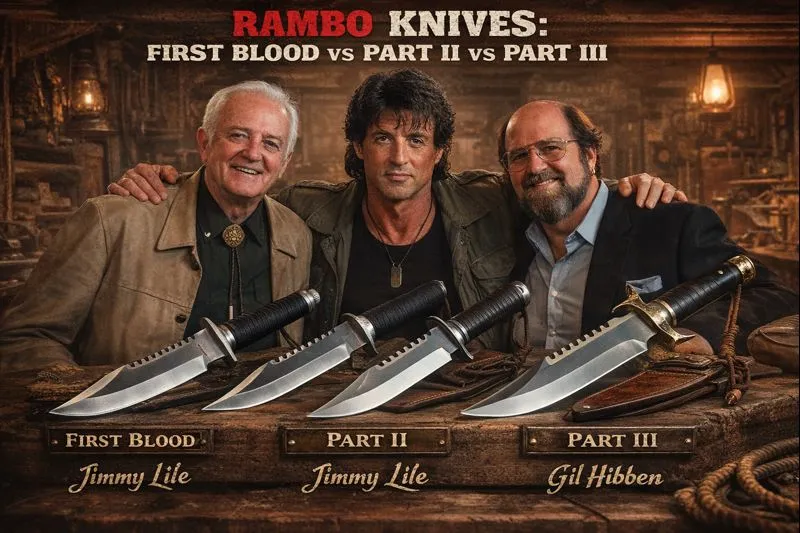
When we talk about famous movie knives, John Rambo’s knives are always at the top of the list. These knives changed a lot from First Blood to Rambo III, and this change is not only about looks. It mainly happened because different knife makers designed them, each with a very different style and mindset.
The knives in First Blood and First Blood Part II were designed by Jimmy Lile, a well-known knifemaker from Arkansas. Lile believed in making strong, practical survival knives that could be used in real life. His “Mission” idea was simple: a knife should be a useful tool, not just a movie prop. That’s why the First Blood knife feels solid, balanced, and realistic. It looks like something a real survival expert would carry.
For Rambo Part III, Sylvester Stallone chose Gil Hibben to design the knife. Hibben was famous for creating bold and fantasy-style knives that look powerful and dramatic on screen. Stallone wanted a more detailed and eye-catching design, but Jimmy Lile couldn’t afford to produce such an elaborate knife. Because of this, Hibben stepped in. The Rambo III knife looks impressive and aggressive, but it is less practical for real survival use. Understanding these designers helps us see why the knives are so different and why the “best” Rambo knife depends on whether you prefer real-world function or movie-style flair.
First Blood Knife: The Original Survival Tool:
Jimmy Lile designed the First Blood knife in 1982 as a real survival tool, not just a movie prop. Created by Jimmy Lile, it focused on usefulness, strength, and smart design. The knife features a 9-inch blade made from 440C stainless steel, known for durability and rust resistance. On the spine, 14 saw teeth allow cutting through wood and small branches when needed. The hollow handle includes a waterproof screw-on cap that stores a small survival kit with matches, fishing line, a compass, a needle, and thread.
The handle is wrapped in paracord, which can be removed and used for shelter, tying, or emergency repairs. The guard also includes screwdriver tips, adding extra functionality. Every part of this knife had a purpose, making it a practical survival companion. This thoughtful design is why the First Blood knife remains the most respected and realistic Rambo knife ever made.
Rambo: First Blood Part II Knife: Refined but Familiar:
The knife used in Rambo: First Blood Part II (1985) was again designed by Jimmy Lile, following the same Mission series idea from the first film. Instead of completely changing the design, Lile refined it to make it stronger and more practical for the intense jungle missions in the sequel. Compared to the First Blood knife, this version had a matte black coating instead of the shiny finish, reducing glare and giving it a tactical look.
The blade shape was slightly updated, keeping the balance but making it more aggressive, while the saw teeth were changed to be flatter and spaced differently to improve utility in survival situations. The sheath was improved too, replacing the rectangular whetstone with a metal sharpening steel, making edge maintenance easier. The knife was slightly bigger overall, at 15.5 inches, compared to 14.75 inches in the first film. This knife is an evolution, not a revolution, keeping the features that worked while refining the details for Rambo’s more challenging missions.
What Changed When Rambo Met Gil Hibben for Part III?
When Rambo III (1988) came around, the knife got a big change. Sylvester Stallone wanted a larger, more exotic Bowie-style knife that looked impressive on screen. Jimmy Lile couldn’t take the project because it would have been too expensive to produce, so Gil Hibben stepped in to design Rambo’s new iconic knife. Hibben tried several prototypes, including hollow handles, before choosing a full tang construction for strength.
The final knife measured 16 inches overall, with an 11 7/8 inch blade made of 5/16 inch thick 440C steel. It had the famous 3 3/4 inch blood groove, five saw teeth representing Rambo’s unit members (one bigger tooth for Delmar Barry), a laminated hardwood handle, and a more decorative guard. This knife was a shift from a simple survival tool to a fantasy-style combat knife. It was still fully functional, but with more style and drama, making it perfect for the bigger action scenes in Rambo III.
Rambo Knives Comparison:
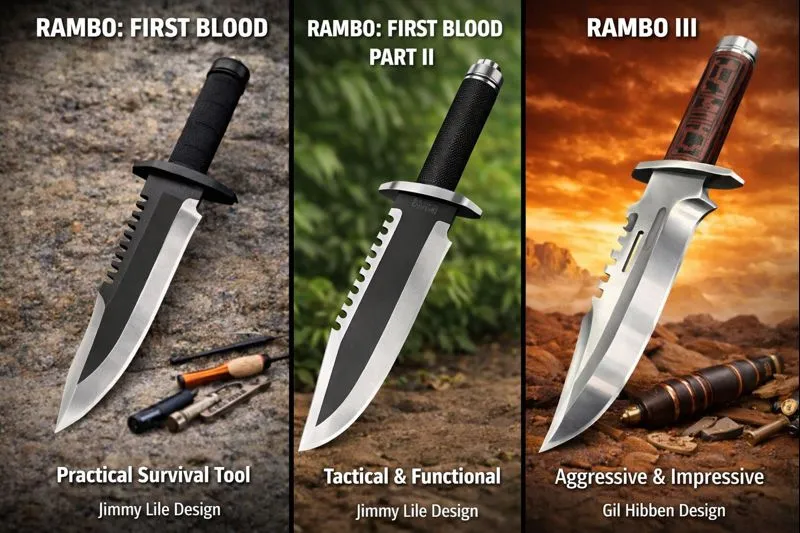
1. Features and Specifications:
| Feature / Specification | Rambo I – First Blood | Rambo II – First Blood Part II | Rambo III |
| Overall Length | ~14 inches (35.5 cm) | ~15 inches (38 cm) | ~18 inches (45.7 cm) |
| Blade Length | ~9 inches (22.9 cm) | ~10 inches (25.4 cm) | ~11.5 inches (29.2 cm) |
| Blade Thickness | ~6.4 mm | ~6.4 mm | ~6.8 mm |
| Blade Material | High-carbon stainless steel | High-carbon stainless steel | High-carbon stainless steel |
| Blade Finish | Satin / bead-blast | Blackened / matte tactical finish | Blackened tactical finish |
| Blade Shape | Bowie clip point | Modified Bowie with reinforced spine | Long Bowie with aggressive profile |
| Saw Teeth Count | 14 saw teeth | 14 saw teeth | 11 large aggressive teeth |
| Saw Teeth Design | Angled, multi-directional | Sharper, deeper survival saw | Wider, deeper, wood-focused teeth |
| Handle Construction | Hollow handle with knurled grip | Hollow handle, improved sealing | Hollow handle, thicker walls |
| Handle Material | Knurled steel | Knurled steel | Knurled steel |
| Weight (approx.) | ~1.3 lbs (590 g) | ~1.4 lbs (635 g) | ~1.7 lbs (770 g) |
| Tang Construction | Hollow handle (not full tang) | Hollow handle (not full tang) | Hollow handle (reinforced) |
| Survival Kit Included | Yes (capsules, matches, compass) | Yes (expanded kit) | Yes (simplified kit) |
| Guard Features | Single cross guard | Double guard with lashing holes | Larger double guard |
| Pommel Design | Screw-on compass pommel | Compass pommel, stronger threads | Flat pommel with compass |
| Original Designer | Jimmy Lile | Jimmy Lile (inspired) | Gil Hibben (inspired) |
| Year Introduced | 1982 | 1985 | 1988 |
| Intended Purpose | Survival, bushcraft, escape | Combat-survival hybrid | Heavy combat & field use |
| Film Association | First Blood | Rambo: First Blood Part II | Rambo III |
2. Which Knife Wins for Survival Situations?
When it comes to real survival, the First Blood and Part II knives are the clear winners. Both were designed by Jimmy Lile as practical survival tools, not just movie props. Their hollow handles store essential survival items like a compass, matches, fishing line, needle, and thread things that could help you navigate, start a fire, or catch food if lost in the wilderness. The knives are also lighter and easier to carry, making them ideal for long hikes or dense terrain.
Their saw teeth allow cutting wood for building shelters or gathering firewood, and the screwdriver tips plus paracord-wrapped handles add extra functionality for repairs, traps, or securing gear. The Rambo III knife, designed by Gil Hibben, looks dramatic and bold but sacrifices survival practicality. It is heavier, lacks a survival kit, and is harder to control for detailed tasks like carving wood or preparing food. While Rambo III looks impressive on screen, First Blood and Part II knives are far more useful for genuine survival situations.
3. The Combat Effectiveness: Which Blade Dominates?
If we look at the knives from a combat or tactical point of view, the Rambo III knife clearly has the edge. It is bigger, heavier, and built stronger. Its thicker blade, longer reach, and strong full‑tang construction make it more durable and powerful for striking. The blood groove also helps reduce weight while keeping strength, making the blade more effective in intense combat-style situations. Overall, it feels aggressive and built for strength rather than utility.
However, the First Blood and Part II knives still have advantages. They are smaller, lighter, and easier to control, making them faster to deploy and better for close‑quarters movement. Their blade shape, closer to a traditional Bowie-style clip point, allows for quicker handling and precise movement, while the Rambo III knife focuses more on raw power. For UK readers, this comparison is purely academic, as these knives are not legal to carry for self‑defence. In conclusion, Rambo III dominates in pure combat effectiveness, but Part II offers better balance and versatility overall.
4. Build Quality and Durability: Which Design Lasts Longest?
When we look at build quality and durability, the design of a knife really matters. A full tang knife, like the Rambo III, is naturally stronger because the blade runs through the handle, leaving no weak spots. Hollow handle designs, like some original Lile knives, have a weak point where the handle screws onto the tang, but the originals were made with high-quality materials and can last decades if cared for.
All three knives use 440C steel, though heat treatment can affect toughness and edge retention. Handles differ, too; cord wrap grips well but can wear, while hardwood is strong but may crack if wet. Modern replicas vary widely in quality, so always check before buying. Cleaning, oiling, and safe storage help any knife last longer.
Are Rambo Knives Actually Practical or Just Movie Props?
Many people wonder if Rambo knives actually work in real life or are just Hollywood fantasy. The honest answer is that it depends on the design. The First Blood and Part II knives, created by Jimmy Lile, were designed as genuine survival tools. They are functional, with features like hollow handles with survival kits, saw teeth, paracord-wrapped handles, and multi-tool elements. These knives could work well for survival tasks like building shelter, starting a fire, or catching food. However, they are larger and heavier than most campers need, and the hollow handle creates a structural weak point compared to full-tang designs.
The Rambo III knife, designed by Gil Hibben, is more fantasy than function. Its larger size, heavier weight, and decorative elements like the blood groove and ornate guard look dramatic but add little practical value. Today, all three knives are best suited for collectors and display, though high-quality replicas can still be used as backup or emergency knives.
Final Verdict: Which Rambo Knife Reigns Supreme?
There is no single “best” Rambo knife, because each one is best in its own way. The knife from First Blood is the winner for history, as it is the original knife that started the Rambo craze and is still the most iconic. The knife from part 2 wins for overall balance, as it improves the original design and feels more practical and comfortable to use for different purposes.
The knife from Rambo III stands out for its bold look, strong collector demand, and powerful combat-style design, making it the most popular replica and the best choice for display. For real survival-style use, First Blood or Part II are better options. For collecting, First Blood originals or Rambo III replicas are ideal. In the UK, these knives are legal to own at home but not legal to carry in public without a valid reason.
Final Thoughts:
Rambo’s knives are more than just movie props; they each have their own story, design style, and purpose. The First Blood knife is the classic original, built for real survival, and still the most iconic. The Part II knife refined that design, keeping all the survival features while improving balance, blade shape, and sheath, making it the most well-rounded choice for practical use. The Rambo III knife is the boldest and flashiest, designed by Gil Hibben for visual impact, combat-style strength, and collector appeal.
If you’re thinking about practical survival, go with First Blood or Part II. For collecting or displaying, the Rambo III knife or the First Blood original is perfect. Just remember, in the UK, these knives are legal to own at home but not legal to carry in public without a valid reason. No matter which knife you prefer, each one shows the skill and vision of its designer and the legacy of Rambo on screen.