
Blog
A Beginner’s Guide to Viking History and Norse Civilisation

Viking history is full of fascinating stories, brave explorers, powerful traditions, and a rich culture that still interests people today. The Vikings came from Scandinavia and became known for their voyages, trading, settlements, and adventures across Europe and beyond. But there is much more to Norse civilisation than the image of fierce warriors and longships.
In this beginner’s guide, we will explore the history of the Vikings and learn how Norse people lived, worked, travelled, and worshipped. We will also look at their gods, beliefs, social life, traditions, ships, and important achievements. Whether you are just starting to learn about Viking history or want to understand Norse civilisation better, this guide will help you discover the Viking Age in a simple and easy-to-follow way.
2. Who Were the Vikings?
The Vikings were people from Scandinavia, mainly from Denmark, Norway, and Sweden, who lived during the Viking Age from around 793 to 1066 AD. The word “Viking” is commonly associated with travelling or going on an overseas journey. Vikings were not just warriors. Many were farmers, traders, sailors, explorers, and skilled craftsmen.
They travelled across Europe and reached places such as Iceland, Greenland, and North America. Some Vikings raided towns and monasteries to gain wealth and supplies, while others travelled to trade, settle new lands, or find new opportunities. Their journeys helped spread Norse culture, traditions, and influence across many parts of the world.
3. Viking Society and Social Structure
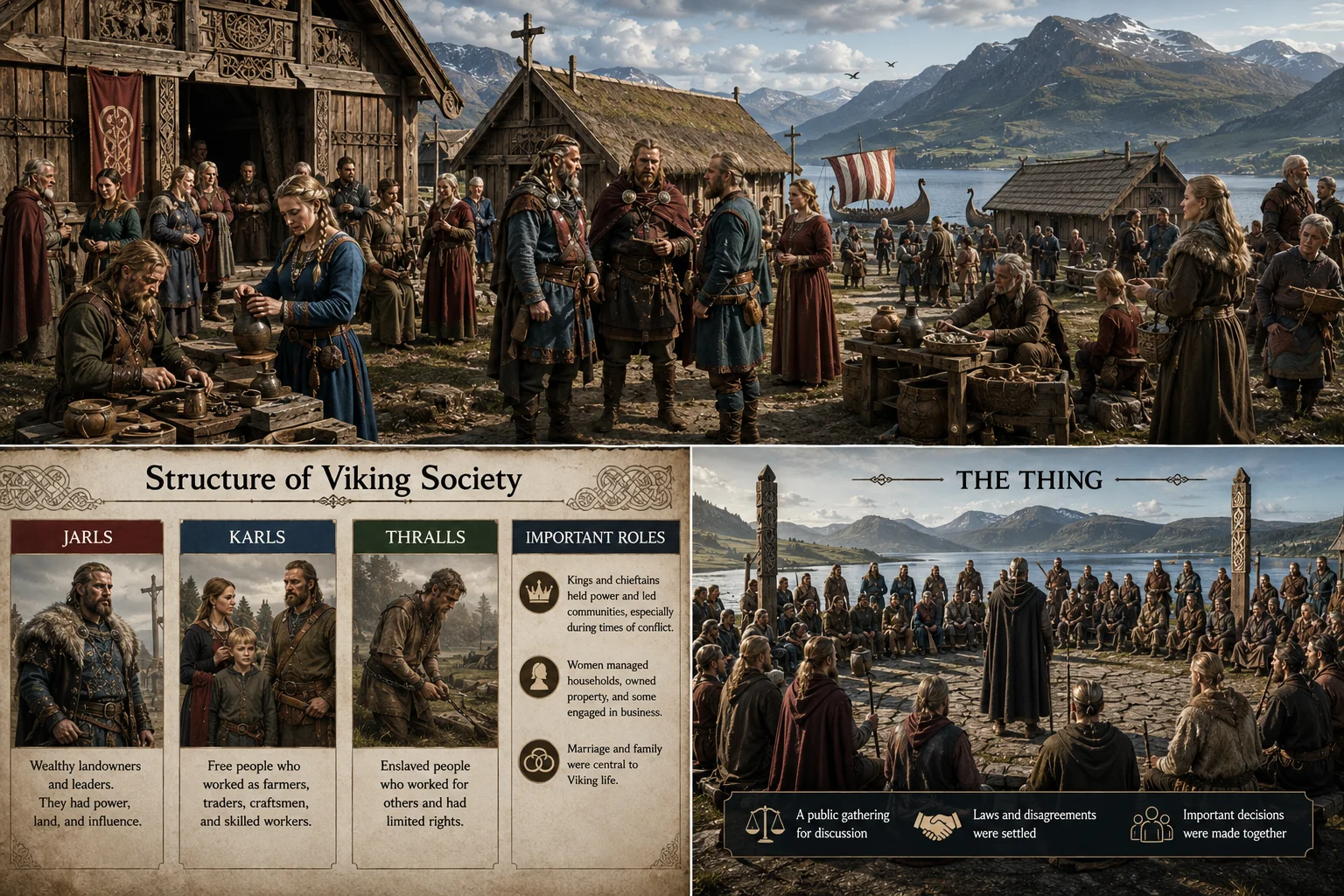
Viking society was divided into different social groups, including chieftains, farmers, traders, craftsmen, and enslaved people. Wealth and status often influenced a person’s position in society. Families and communities played an important role, while skilled workers helped keep daily life running. Women also had important responsibilities within Viking households.
1. Structure of Viking Society
Viking society was organised into different social groups, with Jarls, Karls, and Thralls forming the main classes. Jarls were wealthy landowners and leaders, while Karls were free people who worked as farmers, traders, and craftsmen. Thralls were enslaved people who worked for others and had limited rights.
Kings and chieftains held power and led communities, especially during times of conflict. Women played an important role in family life and household management, and some could own property and take part in business. Marriage and family were central to Viking communities. The Thing was a public gathering where people discussed laws, settled disagreements, and made important decisions.
4. What Did the Vikings Believe In?
What Did the Vikings Believe In?
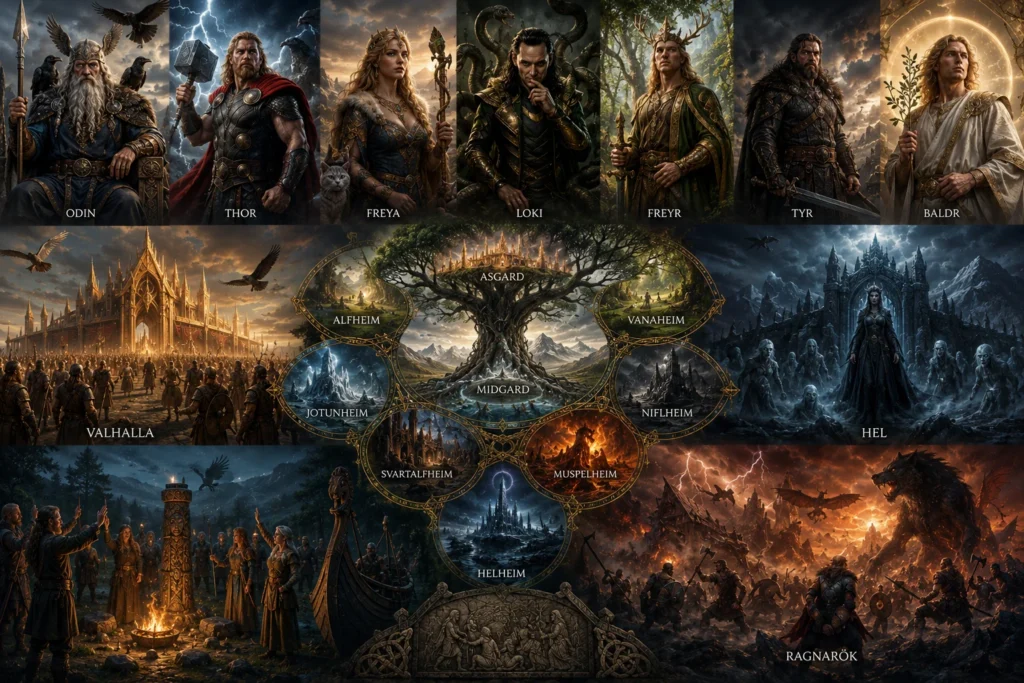
The Vikings followed Norse religion and believed in many gods, including Odin, Thor, Freyja, and Freyr. Their beliefs included myths about Asgard, Midgard, and Valhalla. They also believed in fate, honoured their ancestors, and held rituals and festivals to respect their gods and natural forces.
1. Norse Gods and Pantheon
Norse mythology featured many gods and goddesses, each with their own roles and stories. Odin represented wisdom, knowledge, war, and death, while Thor ruled thunder and offered protection. Freya represented love, fertility, beauty, and war. Loki was a clever and unpredictable figure known for his tricks and changing nature. Other important Norse gods included Freyr, Tyr, and Baldr, who also played important roles in Norse myths.
2. Norse Mythology and Afterlife Beliefs
Norse mythology had fascinating ideas about life, death, and the afterlife. Warriors who died bravely in battle were believed to have a chance to reach Valhalla, the hall of Odin. Hel was another realm associated with the dead. At the centre of Norse mythology stood Yggdrasil, the great tree connecting the Nine Realms.
Norse beliefs also included Ragnarök, a great series of events involving battles, destruction, and the deaths of several gods. These stories helped Vikings understand fate, courage, death, and the changing nature of the world.
5. Runes and Viking Culture
Runes were an important part of Viking culture and were used as a writing system in Scandinavia. Vikings carved runes into wood, stone, metal, and other materials to record names, messages, memorials, and important events. Some runic inscriptions also reflected religious beliefs and traditions.
Different forms of runes were used during the Viking Age, with the Younger Futhark being especially common. Runestones found across Scandinavia provide valuable information about Viking people, their journeys, families, beliefs, and achievements, helping historians understand Norse society and daily life.
1. Viking Writing System
Viking runes were used to write names, short messages, memorials, and important information. During the Viking Age, the Younger Futhark was commonly used, while the earlier Elder Futhark belonged to an older period. Vikings carved runes into stone, wood, metal, and other materials.
Runestones often recorded family connections, journeys, achievements, or memorials for the dead. Today, these inscriptions provide historians with valuable clues about Viking society, language, beliefs, travel, and everyday life. By studying runes, researchers can better understand how Norse people communicated and preserved important memories.
6. Who Were the Most Famous Vikings in History?
Several Vikings became famous through historical records, sagas, and legends. Ragnar Lothbrok is one of the best-known Viking figures, although some stories about him may be legendary. Erik the Red founded a Norse settlement in Greenland, while his son, Leif Erikson, reached North America centuries before Columbus. Ivar the Boneless, Bjorn Ironside, and Harald Hardrada also led major military campaigns and earned recognition for their leadership. Their stories continue to shape our understanding of Viking exploration, warfare, and Norse history.
1. Ragnar Lothbrok — Legendary Viking Figure
Ragnar Lothbrok is a famous figure from Norse sagas and legends, often described as a brave warrior and successful leader. Stories connect him with raids across England and France and with several sons. However, historians have found limited evidence that confirms Ragnar as a historical person. His story likely combines history, legend, and later storytelling.
2. Erik the Red and Leif Erikson — Western Explorers
Erik the Red was a Norse explorer who established a Viking settlement in Greenland after being exiled from Iceland. His son, Leif Erikson, later travelled west and reached North America, according to Norse sagas.
Around the year 1000, Leif and his crew are believed to have explored a region called Vinland. Archaeological evidence at L’Anse aux Meadows in Newfoundland supports the presence of Norse settlers in North America during this period.
3. Ivar the Boneless and the Great Heathen Army
Ivar the Boneless was a well-known Viking leader associated with the Great Heathen Army, a large Viking force that invaded England in the 860s. The army fought against several Anglo-Saxon kingdoms and captured key territories, changing the course of English history.
Ivar appears in both Anglo-Saxon historical records and Norse sagas, although some details about his life are uncertain. His story combines historical events with later legends, making him one of the most interesting figures of the Viking Age.
4. Other Notable Viking Leaders
Several Viking leaders played important roles in Scandinavian and European history. Harald Bluetooth helped unite Denmark and supported the spread of Christianity in the region. Harald Hardrada was a powerful Norwegian king who fought across Europe before making his final attempt to conquer England in 1066. Cnut the Great became king of England, Denmark, and Norway, creating a powerful North Sea empire. Their leadership and achievements had a lasting impact on Viking and medieval history.
7. What Made the Vikings So Powerful?
The Vikings became powerful because of their strong ships, skilled sailing, organised communities, and effective fighting methods. Their longships allowed them to travel quickly across seas and rivers, reaching places that were difficult to access. They were also skilled traders, explorers, and farmers who built strong settlements in new lands.
Good leadership and flexible strategies helped Viking groups succeed in different regions. Their knowledge of the sea, ability to adapt to new environments, and strong social networks played an important role in the growth of Viking influence across Europe and beyond.
1. Viking Weapons and Warfare
Viking warriors used a range of battle gear and protective equipment during conflicts. Viking swords were valuable and often showed a warrior’s wealth and status. Axes were widely used because they were practical and effective in combat. Spears were also common for throwing and close fighting. Warriors carried round wooden shields for protection and sometimes wore helmets and other protective gear. The equipment used by Vikings varied with their wealth, region, and role, and it played an important part in Viking warfare and military culture.
2. The Viking Longship
The Viking longship was one of the most important parts of Norse exploration and travel. Its long, narrow design made it fast and easy to handle on both open seas and shallow rivers. Vikings used these ships for raiding, trading, exploring, and reaching new lands. Their skilled sailors used the sun, stars, landmarks, and knowledge of winds and currents to navigate.
Viking longships travelled across the North Atlantic, reaching places such as Iceland, Greenland, and North America. Their impressive design and sailing skills helped Vikings travel great distances.
8. Viking Raids, Settlements and Voyages of Discovery
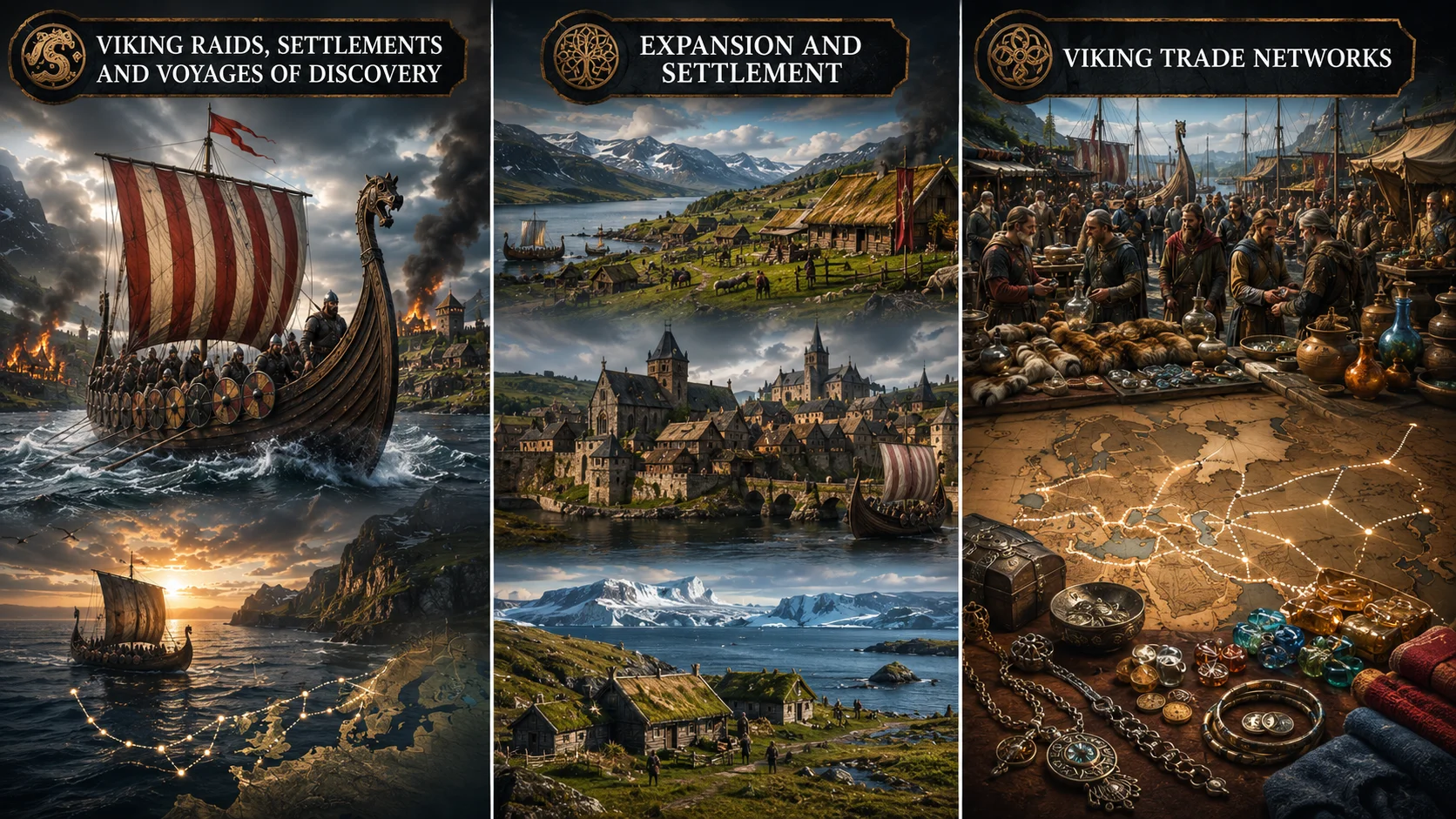
The Vikings travelled widely across Europe and the North Atlantic, taking part in raids, trade, settlement, and exploration. Their fast longships allowed them to reach coastal towns, rivers, and distant lands. They established settlements in places such as England, Ireland, Iceland, and Greenland. Norse explorers also travelled as far as North America.
These journeys were driven by different goals, including finding wealth, new trading opportunities, farmland, and new places to live. Over time, Viking travel helped connect Scandinavia with many different regions and cultures.
1. Expansion and Settlement
Vikings travelled widely across Europe and established settlements in several regions. They raided coastal areas of England and Ireland before settling there and becoming part of local communities. In England, Viking-controlled areas became known as the Danelaw.
Viking settlers also shaped the history of France and Normandy, where Norse settlers established a powerful duchy. Further west, they settled Iceland and Greenland and later reached North America. These journeys expanded Norse culture, trade, and influence far beyond Scandinavia.
2. Viking Trade Networks
Vikings were skilled traders who built wide trading networks across Europe and beyond. They traded goods such as furs, amber, walrus ivory, honey, iron, textiles, and slaves, exchanging them for silver, spices, glass, and other valuable items. Important trading centres included Hedeby, Birka, and Dublin, which connected different regions. Viking traders also travelled east through rivers and linked with trade routes leading towards Byzantium and the Islamic world. These connections helped Vikings exchange goods, ideas, cultures, and technologies across a large part of the medieval world.
9. What Was Everyday Life Like in the Viking Age?
Everyday Viking life focused on family, farming, fishing, and community. Most people lived in simple homes and worked to support their households. They made clothing, tools, and other useful items by hand. Families shared responsibilities, while festivals, feasts, and community gatherings brought people together throughout the year.
1. Food, Farming and Economy
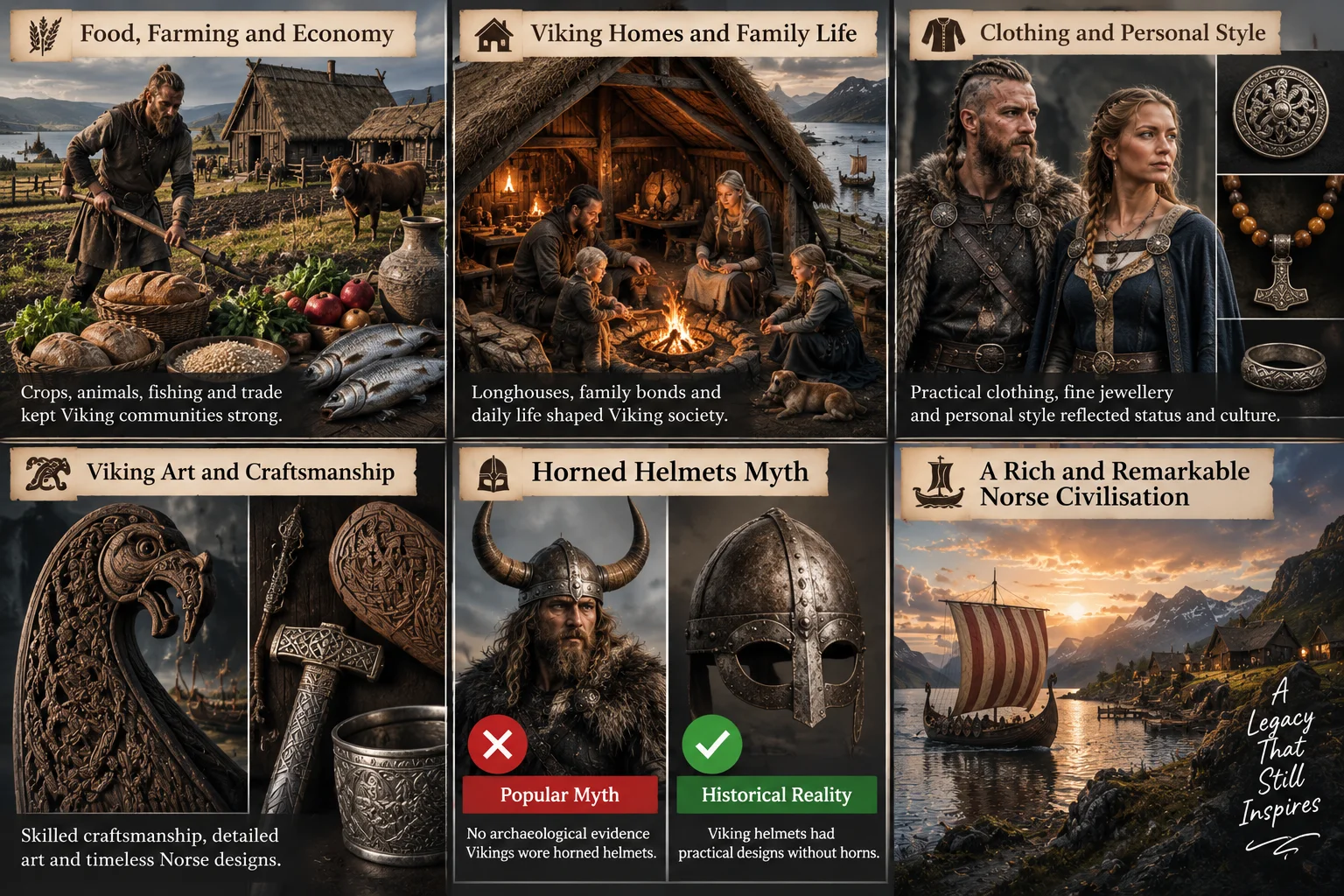
Food and farming were an important part of Viking life. People grew barley, oats, rye, and vegetables and kept animals such as cattle, sheep, goats, and pigs. They also relied on hunting and fishing for meat and fish. Common foods included bread, porridge, dairy products, and preserved meat. Markets and trading centres allowed Vikings to buy, sell, and exchange goods such as food, clothing, tools, and crafts. Farming, fishing, hunting, and trade helped support Viking families and communities.
2. Viking Homes and Family Life
Food and farming were an important part of Viking life. People grew barley, oats, rye, and vegetables and kept animals such as cattle, sheep, goats, and pigs. They also relied on hunting and fishing for meat and fish. Common foods included bread, porridge, dairy products, and preserved meat. Markets and trading centres allowed Vikings to buy, sell, and exchange goods such as food, clothing, tools, and crafts. Farming, fishing, hunting, and trade helped support Viking families and communities.
3. Clothing and Personal Style
Viking clothing was practical, comfortable, and suited to the cold Scandinavian climate. People commonly wore garments made from wool and linen, while cloaks and layered clothing provided extra warmth. Wealthier people could wear finer fabrics and more detailed designs. Jewellery was also popular and included brooches, rings, beads, and pendants made from materials such as silver, bronze, glass, and amber. Clothing and personal decoration could reflect a person’s wealth, social position, and cultural traditions.
4. Viking Art and Craftsmanship
Viking art was known for its detailed designs, skilled craftsmanship, and strong connection to nature and mythology. Woodcarvers decorated ships, buildings, furniture, and everyday objects with animals and flowing patterns. Skilled metalworkers and blacksmiths created jewellery, tools, fittings, and other useful items from iron, bronze, silver, and gold. The Oseberg style, known for its graceful animal shapes and complex patterns, is one of the best-known forms of Viking art. These traditions show the creativity, skill, and attention to detail found in Norse craftsmanship.
5. Horned Helmets Myth
Many people picture Vikings wearing horned helmets, but this is a popular myth. There is no confirmed archaeological evidence that Vikings used horned helmets. The image became popular in the 19th century through opera costumes and later spread through films, TV shows, and modern designs. Archaeological finds show that Viking helmets had practical designs without horns, making the famous horned look more fiction than history.
10. Viking Death, Burials and Archaeological Discoveries
Death and burial were important parts of Viking culture, and burial customs could vary between communities and social groups. Some people were cremated, while others were buried in the ground with personal belongings, jewellery, tools, or other items.
Famous ship burials, such as those found at Oseberg and Gokstad in Norway, provide valuable evidence about Viking life and beliefs. Archaeologists have also discovered burial sites, runestones, tools, and everyday objects that help us understand how Norse people lived, worked, travelled, and remembered their dead.
1. Viking Burial Practices
Viking burial customs varied across regions and social groups. Viking communities buried some people in ships or burial mounds, while others received simpler graves. Families sometimes placed jewellery, tools, clothing, and other personal belongings with the dead. Archaeological discoveries of Viking graves provide valuable clues about Norse beliefs, status, traditions, and daily life.
11. How Did the Viking Age End?
The Viking Age gradually came to an end around 1066 AD as Scandinavian societies changed and became more closely connected with the rest of Europe. The spread of Christianity, stronger kingdoms, better-organised governments, and changing trade routes reduced the need for traditional Viking raids. The failed Norwegian invasion of England and the Battle of Stamford Bridge in 1066 marked an important symbolic end to the Viking Age. However, Norse culture and influence continued long after this period.
1. Decline of Viking Power
The decline of Viking power happened gradually as Scandinavia became more connected with Christian Europe. Christianity spread across Denmark, Norway, and Sweden, changing religious and social traditions. At the same time, stronger European kingdoms developed better-organised armies and governments. Changes in warfare and trade also reduced the importance of Viking raids. By around 1066, the Viking Age was coming to an end, although Norse culture and influence continued for many years.
12. How Do the Vikings Still Influence Us Today?
The Vikings continue to influence modern culture in many ways. Their history, mythology, art, language, and exploration still attract people around the world. Norse gods such as Thor and Odin appear in books, films, games, and television shows.
Viking designs can also be seen in jewellery, clothing, artwork, and modern entertainment. Archaeological discoveries and historical research help us understand their way of life. Their stories of exploration, courage, and adventure continue to inspire people and keep interest in Viking history alive today.
1. Viking Influence on Language and Place Names
The Vikings had a lasting influence on the English language and place names, especially in northern and eastern England. Some common English words, such as sky, egg, window, law, and husband, have Old Norse roots.
Viking influence can also be seen in many British place names. Names ending in “-by”, such as Derby and Grimsby, come from Old Norse and often mean a farm or settlement. These words and names show how closely Viking settlers became connected with local communities.
2. Vikings in Modern Culture
However, popular culture does not always show Viking history accurately. Films and games may mix real events with legends and myths, such as the famous horned helmet. Learning about historical evidence helps separate the real Viking Age from the stories created by modern entertainment.
13. Viking History: Myths vs. Reality
Many popular ideas about Vikings come from films, television, books, and modern entertainment, so they are not always historically accurate. The famous image of Vikings wearing horned helmets is a later myth with no confirmed archaeological evidence.
Vikings were not only raiders; they were also farmers, traders, sailors, craftsmen, and settlers. Claims about Viking tattoos are also difficult to confirm because clear archaeological evidence is limited. Modern depictions often combine historical facts with legends, making it important to compare popular stories with archaeological discoveries and historical records.
14. What Is the Difference Between Vikings and Norse People?
The terms Vikings and Norse people are related, but they do not mean the same thing. “Norse people” refers broadly to the people of Scandinavia and their culture during the Viking Age and earlier periods. “Viking” usually describes people who took part in overseas journeys for raiding, trading, exploring, or settling. So, not every Norse person was a Viking. Many Norse people stayed at home as farmers, craftsmen, traders, or families, while others travelled across Europe and beyond.
Final Thoughts:
Viking history is much more than stories of raids and battles. The Vikings were farmers, traders, sailors, explorers, craftsmen, and settlers who built a rich culture that still interests people today. Their beliefs, mythology, ships, art, language, and traditions have left a lasting mark on history.
Learning about the Viking Age also helps us understand the difference between historical facts and popular myths. While many modern stories add fiction to Viking history, archaeological discoveries and historical records give us a clearer picture of how Norse people actually lived. From Scandinavia to distant lands, their journeys and culture continue to shape how we see this fascinating period of history.